- Resources
- Blog
5 ways eSIMs help edge AI move smarter and faster
 Bee Hayes-Thakore
 In just a few weeks, some of the industry’s biggest stages have converged on the same story. MWC Barcelona 2026 brought together nearly 105,000 attendees, while Embedded World 2026 in Nuremberg welcomed around 36,000 visitors, both signaling how tightly compute, connectivity, security, and embedded intelligence are now intertwined. At NVIDIA GTC 2026, “physical AI” was pushed into the center of the conversation, with robotics, inference, and AI infrastructure taking top billing across the event and its online coverage.
At Kigen, our team came back from recent events with more than 200 customer conversations around cybersecurity, connectivity growth and physical AI, nearly a million cumulative step count behind us, and a simple conclusion: eSIM now sits at the convergence of three shifts.
First, connectivity is moving from removable SIMs to standards-based, secure-server-based, and remotely managed eSIMs, which also reduce plastic and logistics overhead.
Second, digital transformation is moving from the M2M era where sensors that merely report into fully cognizant edge IoT systems that decide and act locally, where latency, cost, and resilience matter. I, for one, am glad to see that we have moved from the thinking that everything had to be done on the cloud to feed big data!
Third, mobile is being redefined by industrial IoT, wearables, vehicles, utilities, and intelligent devices, not just smartphones. The result is a bigger role for secure, programmable connectivity at the edge.
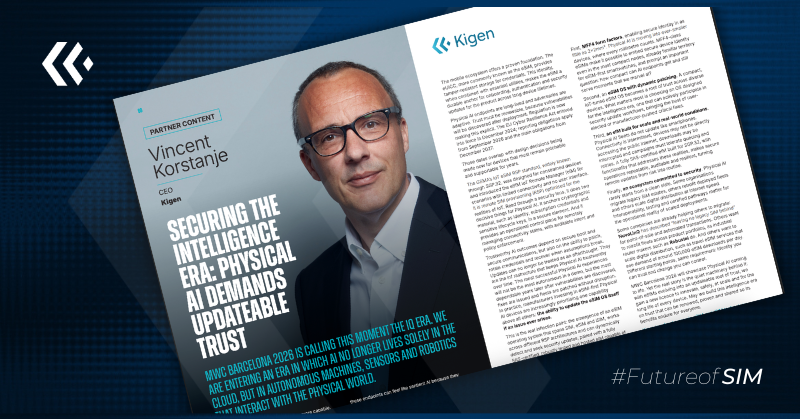
Further reading: Vincent Korstanje, CEO of Kigen, discusses securing AI in the physical world at MWC
So, what did we learn? Let me summarize:
Here are five reasons eSIM integrations are becoming irresistible for edge AI investment.
1) SGP.32 has moved from theory to execution. Is your CMP ready?
The new GSMA IoT eSIM standard, SGP.32, is no longer a talking point looking out to the future. It is becoming real in the market. Kigen’s own SGP.32 offering frames it as the basis for global interoperability in IoT eSIM deployments, and the ecosystem is already moving from standards work into operational rollout. In recent weeks alone, floLIVE announced full operational support built on Kigen technology, Stacuity announced integration with Kigen’s SGP.32 eSIM approach, and Trasna announced collaborating deeper with their SM-DP+ and Kigen’s eIM and eSIMs. Further, we are proud to align with our ecosystem, as Soracom has opened pre-orders for SGP.32-compatible orchestration, and Goodix has announced dual global security certifications for its eSIM solution, co-developed with Kigen.
That is what market readiness looks like: the stack is forming across eSIM OS, eIM, orchestration, and security.
2) eSIM opens growth markets far beyond smartphones.
The most interesting connected devices now sit in places where size, power, and durability matter more, and challenge all legacy assumptions. Garmin’s fēnix 8 Pro is a strong signal: it combines cellular and satellite connectivity, and it won the 2026 GLOMO award for Best Connected Consumer Device. Skylo has also publicly highlighted its work enabling direct satellite messaging and SOS on the device. This is the broader opportunity for eSIM: wearables, mobility devices, automotive platforms, and new ambient computing form factors all need secure connectivity in miniature designs. As these products become more AI-assisted, eSIM gives manufacturers a way to scale service delivery without scaling physical complexity. There were some notable examples of travel eSIMs already integrated into everyday services – a trend that is driving further consumer eSIM adoption and increasingly, going beyond smartphones alone. More to watch in this space!
3) Cyber resilience is becoming a product requirement, not a nice-to-have.
Consumer asset tracking and specialized smartphone or robotic solutions continue to evolve. At MWC26, we met with several vendors offering tracking products used by families, children, and pets, as well as vehicles, or mechatronic systems that would be assistive for all.
The regulatory direction for OEMs is unmistakable: consumers deserve these devices to remain secure. The EU Cyber Resilience Act creates cybersecurity requirements for products with digital elements, and the European Commission explicitly frames it around products being designed, updated, and maintained securely. NIS2 has already raised the baseline across critical sectors, and in the US, Executive Order 14028 continues to shape expectations around software supply chain integrity and cybersecurity modernization. NIST’s IoT cybersecurity program and its updated manufacturer guidance reinforce the same message: security must extend across the lifecycle, including post-market updates.
For device makers, dependable connectivity is strategic. A secure eSIM foundation can help ensure products still have a trusted path back to the server when urgent patches or policy changes need to be delivered.

4) Private LTE and 5G need more flexible identity and control.
Utilities, smart meters, logistics fleets, and industrial systems do not live only in the best-covered public network zones. They cross private coverage, hybrid environments, roaming scenarios, and sovereign data requirements. That is why the value of eSIM is not just activation. It is control over how connectivity is operationalized, optimized, and changed over time. Kigen’s recent messaging with partners such as Digi and Itron reflects exactly this shift from launch-day connectivity to long-life fleet operations, where resilience, cost control, and staged network evolution matter. For edge AI, that matters even more, because intelligent systems are only useful when they can stay reachable, policy-controlled, and economically sustainable in the field.
5) eSIM strengthens multi-layer AI defenses.
As edge AI becomes more autonomous, trust cannot stop at the model. It has to include identity, provisioning, transport, lifecycle security, and recovery. GSMA-aligned eSIM security frameworks, including eSA certification, matter because they create a verified base layer for connected intelligence. That is especially important in a world of physical AI, where unverified data, spoofed connectivity, or broken update paths can undermine everything built above them. Goodix’s recent eSA milestone and Kigen’s own eSA-certified eSIM positioning show where the market is heading: more intelligence at the edge, but also more insistence on proven security foundations.
The takeaway is simple. eSIM is no longer just about replacing a plastic card. In fact, some vendors are continuing by including SGP.32 eSIMs in SIM form factor for legacy devices, such as the diverse range of Point of Sale or retail payment devices. It is becoming the secure orchestration layer that helps edge AI systems connect, adapt, recover, and scale.
The real question for leadership teams is this: as AI becomes more autonomous at the edge, will your connectivity foundation be a growth enabler, or a constraint on speed, security, and scale?
Get in touch
If you saw the same shift at MWC, embedded world, or GTC, let’s compare notes. Kigen would love to discuss what you are seeing in the market and how eSIM can strengthen your next AI and edge connectivity investment.
Content Authenticity Statement
The research, structural outlining, and content for this article were generated by the author. AI tools were used for proofreading and adjustments to ensure the text can be translated into multiple languages. The final content was reviewed and edited by our team to ensure accuracy.