- Resources
- Blog
- News
SGP.32 eSIM for Point of Sale: The Merchant Connectivity Shift Driving New Revenue
 Bee Hayes-Thakore
 CONNECTED COMMERCE AT THE EDGE STARTS WITH RESILIENT CONNECTIVITY
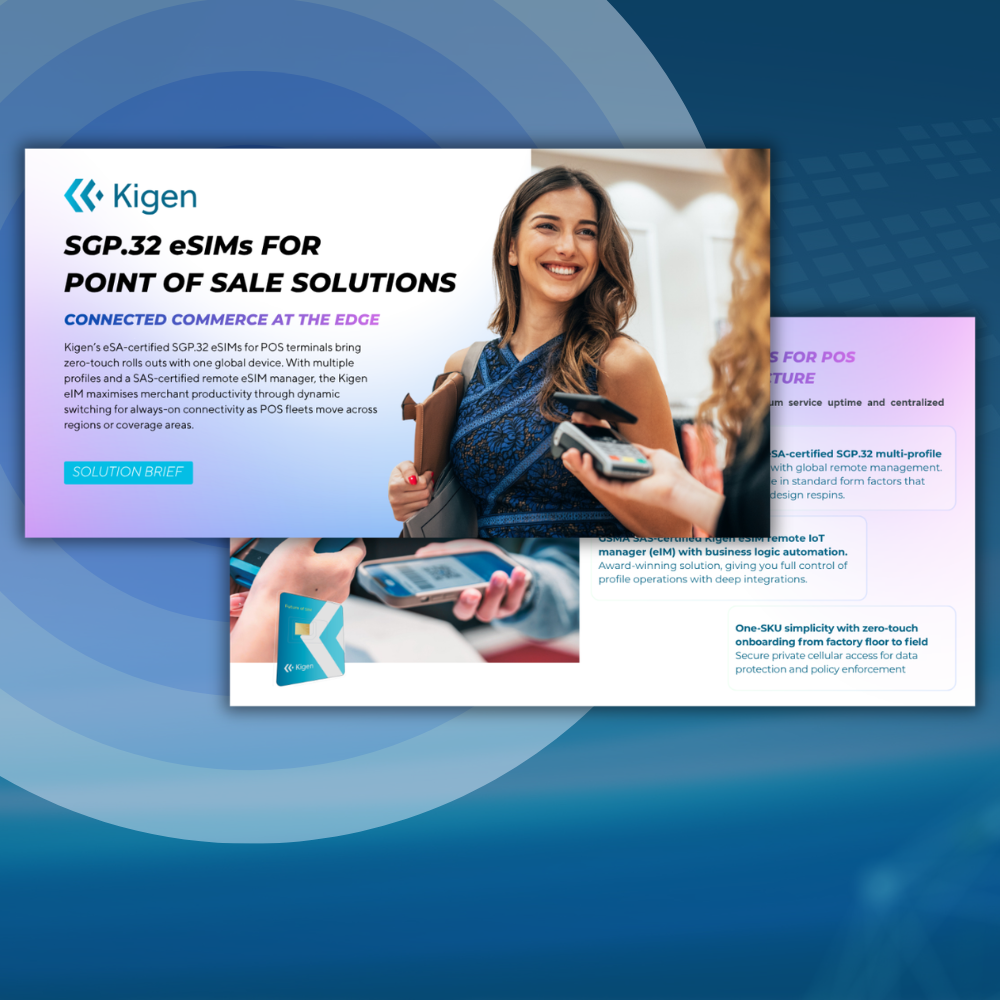
Single-network SIMs built the first generation of smart POS. They will not carry the next one. Contactless payments, digital wallets, and unified commerce have made cellular connectivity mission-critical, and GSMA’s SGP.32 standard is addressing that shift. Multi-profile eSIMs, managed remotely through an eSIM IoT Remote Manager (eIM), replace fixed, carrier-locked SIMs with one global SKU, zero-touch provisioning, and dynamic network switching, built for POS, mPOS, and connected payment devices that never stop transacting.
The cost of staying on single-network SIMs
POS terminals used to stay in one place, on one network. Today’s fleets do not. mPOS devices, kiosks, vending machines, and tolling systems move across regions and coverage areas — and every dropped connection is a fraud window, not just a missed sale. Under EMV liability rules, that cost lands on the bank or retailer running unsecured technology.
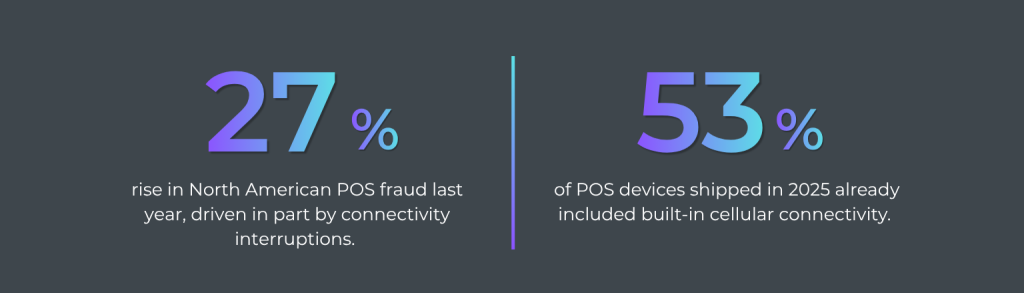
The mobile POS segment is projected to grow roughly 16% annually through 2029. Single-network SIMs cannot keep pace with either number.
What SGP.32 changes for merchant connectivity
SGP.32 is the GSMA’s eSIM standard purpose-built for IoT devices, anchored by two components: eIM, the remote eSIM manager, and IPAe, a lightweight, secure protocol for provisioning and switching network profiles without a truck roll. For manufacturers and merchants, that unlocks:
- One global SKU, zero-touch onboarding. Devices ship identically worldwide and activate connectivity automatically from factory floor to field.
- GSMA eSA-certified, multi-profile eUICCs. Available in standard MFF2 and MFF4 form factors, cutting design respins.
- GSMA SAS-certified remote eSIM management. Business logic automation gives fleet operators full, centralized control of profile operations — no local SIM inventory, no manual swaps.
Network resiliency: the productivity and revenue driver
Dynamic switching is the capability behind every productivity and revenue gain here. When a multi-profile eSIM moves between mobile network operators automatically, POS fleets stay online through coverage gaps and carrier outages instead of waiting on a manual SIM swap.
- Uptime protects revenue. A terminal that cannot authorize a transaction is a lost sale and a fraud liability. Rescue-and-recovery logic detects an outage and fails over automatically, keeping transactions flowing.
- Centralized management cuts operating cost. One dashboard replaces device-by-device intervention — increasingly relevant as banks and retailers issue their own POS hardware as a revenue stream in its own right.
- Compliance is continuous, not reactive. Solderable eUICCs reduce tampering, cryptographically signed profile delivery keeps provisioning PCI-fit, and every device carries a verifiable, immutable identity that shuts down SIM-swapping and impersonation attacks. Kigen’s eUICC and eIM deliver EU Cyber Resilience Act (CRA)-compliant security updates as standard.
New revenue beyond the checkout counter
The same multi-profile eSIM and eIM investment extends well past the POS terminal, opening adjacent connected commerce categories for manufacturers already building on SGP.32:
- IoT vending machines — face recognition, advanced UI, and digital advertising layered onto always-connected hardware.
- Autonomous tolling machines — deployed across airports, stations, and urban hubs, kept online for uninterrupted service and centralized fleet control.
- Reverse vending machines (RVMs) — purpose-built return points for recyclables, rewarding users in real time.
- Sound boxes — emerging voice interaction and gesture recognition features opening new automated service revenue.
What’s next at the edge of connected commerce
Autonomous IoT payments market size surpassed $37 billion in 2023 and is expected to grow at a compound annual growth rate (CAGR) of around 40% from 2024 to 2032, driven by rising consumer demand for convenience.
eSIM-enabled smartphones with tap-and-go capabilities, along with eSIM-first smartwatches and wearables, are set to drive this growth, underscoring the pivotal importance of the IoT eSIM (GSMA SGP.32) transition.
In India, where Kigen has our customer excellence centre, voice is becoming the next payment frontier with mobile payments woven into the cohesive Unified Payment Interface. The number of UPI transactions has increased in the last ten years from 20 million to more than 241 billion. The scale already represents a significant market for shaping what’s next: 491 million individuals and 65 million merchants. Hardware-backed security and the use of an industry trust anchor, such as a standards-based eSIM, are essential here to build safeguards against evolving threats, including financial fraud, especially during connectivity failures.
For multilingual regions, such voice authentication approaches are likely to become a mainstream financial inclusion layer that makes digital payments more natural, trusted, and universally accessible.
Looking ahead, AI-driven merchant insights, unified commerce across in-store and mobile channels, edge computing, and 5G-enabled real-time fraud detection are all converging on one requirement: connectivity that is remotely manageable, network-agnostic, and secure by design.
Kigen customers are delivering nearly 50% of the global shift of POS terminals to network-resilient and global solutions, powered by Kigen’s eSIM solution, with native access to 200+ terrestrial and satellite networks.
KIGEN BRINGS UNRIVALLED EXPERTISE IN ESIM CONNECTIVITY: Ready to move your POS or payment device roadmap from single-network SIMs to SGP.32 eSIM? Follow @Kigen and the #FUTUREOFSIM conversation on LinkedIn.