- Resources
- Reports
- White Paper
AIS-140 and beyond: IoT eSIMs for Indian Connected Vehicle Fleets
Building the next generation of connected vehicle fleets
India’s connected mobility market is evolving beyond basic vehicle tracking. AIS-140 requirements have made reliable connectivity essential for public transport and commercial fleets, while manufacturers are increasingly looking to eSIM technology to support advanced telematics, diagnostics, payments and long-term vehicle services.
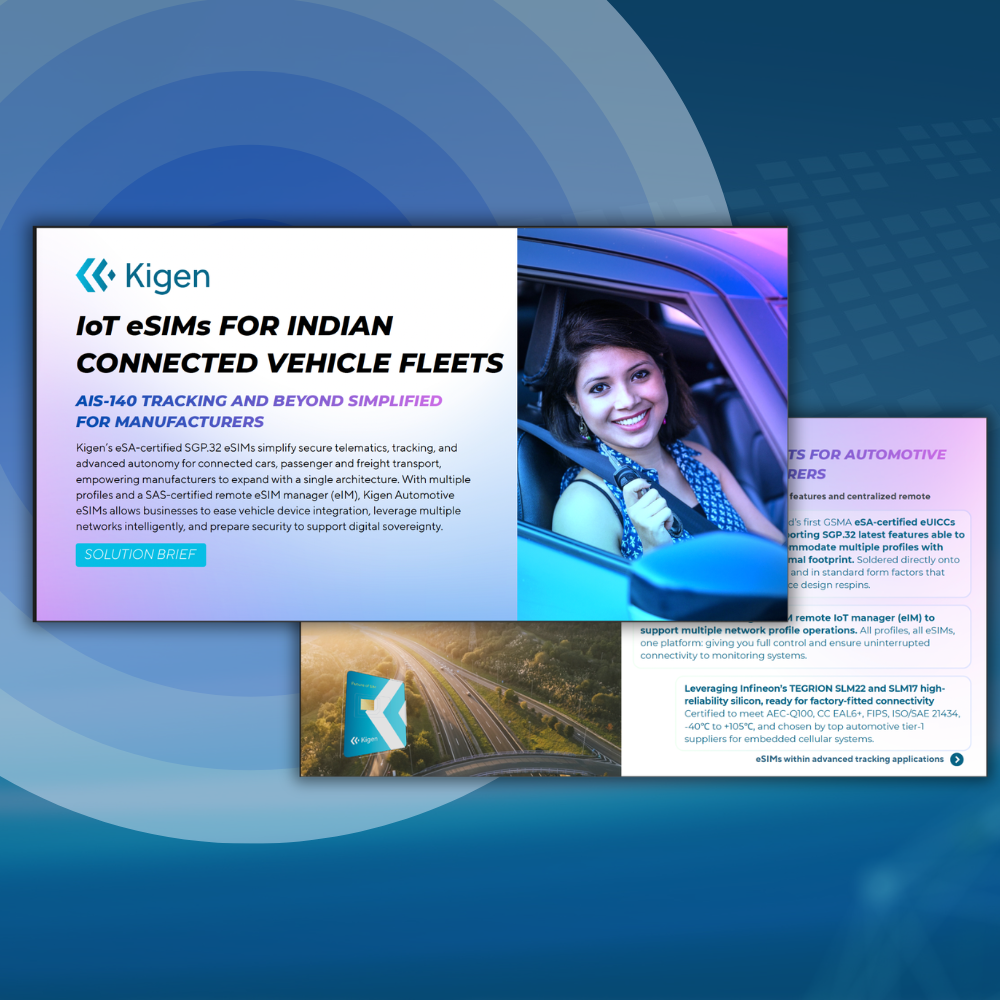
This solution brief explores how Kigen’s eSA-certified SGP.32 eSIM technology and remote eSIM management capabilities can help automotive manufacturers simplify connectivity, securely manage multiple network profiles and build a scalable foundation for connected vehicle fleets.
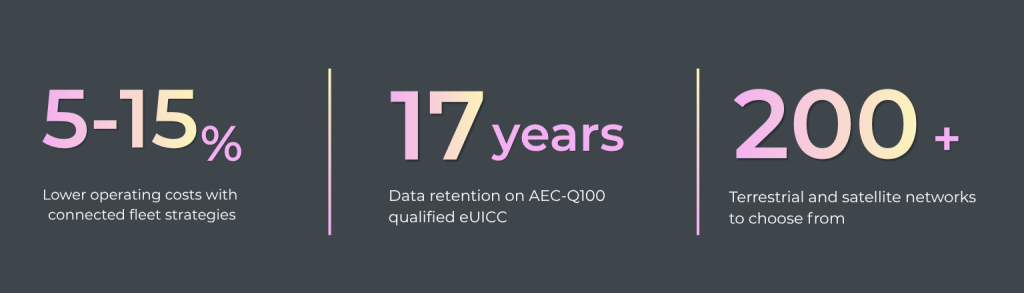
India’s connected fleet opportunity by the numbers
Did you know? India’s road network spans more than 6.62 million km, while road transport carries more than 70% of the country’s freight.
Why AIS-140 is changing fleet connectivity
India’s AIS-140 mandate requires public transport and commercial vehicle fleets to deploy Vehicle Location Tracking Devices. At the heart of each device is an embedded eUICC, and a compliant eSIM must support multi-operator dual profiles so the vehicle stays connected, switching networks automatically if one carrier loses signal.
Requirements vary by vehicle type. AIS-140 is mandatory for commercial cars, taxis, trucks and buses, while basic three-wheelers and e-rickshaws are generally exempt at central level but can be required to track by state, for example in Delhi. At the same time, 2G and 3G network sunsets and the need for emergency and SOS capabilities are making 4G connectivity essential.
How does eSIM inclusion in vehicles support the AIS-140 mandate?
For manufacturers, the challenge is supporting these requirements without adding complexity across vehicle lines. Kigen’s eSA-certified SGP.32 eSIMs and SAS-certified eIM allow multiple network profiles to be provisioned and managed remotely from a single platform, with zero-touch activation across entire fleets.
The eSIM is available in standard MFF2 and MFF4 form factors that are soldered onto the PCB, and uses Infineon automotive security silicon qualified to AEC-Q100. Kigen’s common OS lineage and management approach across Automotive, IoT and Consumer can help OEMs reduce fragmentation across cars, two-wheelers, commercial vehicles and industrial fleets.
Beyond AIS-140 compliance, how can eSIMs support fleet operations for advanced telematics?
Once vehicles are connected securely, the same eSIM can support payments, fuel monitoring, battery telematics and vehicle condition monitoring. For private fleets, connected fleet strategies can contribute to lower operating costs, better fuel efficiency and higher asset utilization. For OEMs, the data layer around the vehicle opens up service, customer engagement and connected-vehicle offerings throughout the vehicle’s life.
“Vehicles are becoming long-lived software platforms, so their connectivity trust anchor must remain secure and manageable long after production.” Vincent Korstanje, CEO, Kigen
What developments should auto device makers and automotive manufacturers be aware of?
Under AIS 140, mandated by ARAI, every public transport vehicle, such as buses and taxis, will have vehicle tracking and an emergency button. This enables foundational tracking capabilities, allowing an AIS-140 GPS device to send data to three servers simultaneously. These servers might include the institution’s server, the SOS server used by the police, and the Government Command and Control center.
Beyond public transport and commercial fleets, automotive manufacturers and device makers should pay good attention to IoT eUICCs and eSIMs, which provide further capabilities:
- Bird’s eye view of all vehicle fleet operations
- Smarter management for fuel and battery life efficiencies
- Equipping fleet optimisations on security and safety
- Bringing next-generation security with Post Quantum era readiness
Kigen eSIMs provide a common OS lineage, hardware platform, development environment, and management approach across Automotive, IoT, and Consumer, helping OEMs reduce fragmentation across passenger cars, two-wheelers, commercial vehicles, and industrial fleets.
Learn how Kigen has been investing in the region with our GSMA SAS-UP eSIM manufacturing for Digital Sovereign capabilities and India’s eSIM ecosystem, as well as extensive work with FWA and CPE, and wearable manufacturers. Kigen continues to champion the needs of manufacturers who need factory-fitted connectivity for their products that innovate customer experiences.