- Resources
- Blog
- News
- Press Release
Why Automakers Are Pivoting to eSIMs for 1 Billion Connected Vehicles by 2035
 Bee Hayes-Thakore
For manufacturers, connected cars, autonomous fleets for cargo and passengers all change the economies of ownership. See how Kigen Automotive eSIMs are designed to respond to the automakers’ need to address long-lasting fleets across network and security shifts.

Connected cars, electrification, and autonomous freight and passenger transport are changing what we expect from mobility. For manufacturers, they also change the economics of ownership: vehicle value increasingly depends on services that must remain available long after production.
Automotive eSIMs enable secure remote provisioning of cellular subscriptions, helping manufacturers adapt fleet connectivity without replacing physical SIMs. Their strategic value lies in their ability to preserve network choice and update trust throughout the vehicle lifecycle.
Why are automakers rethinking fleet connectivity and turning to eSIMs for large fleets?
Omdia forecasts more than 1.05 billion connected vehicles by 2035, up from 473.7 million in 2025. It also warns that operators could begin retiring LTE from 2030. That creates a mismatch between vehicle lifetimes and network roadmaps. Most fleets on the factory floor today will outlive these networks, which has led automakers to embrace eSIM – particularly, IoT eSIMs, for connected telematics functions.
The nature of what such OEM-owned connectivity brings both to the management of fleets, the ability for manufacturers to generate revenue after the first sale, and for safety across an increasingly autonomous infrastructure itself has changed radically.
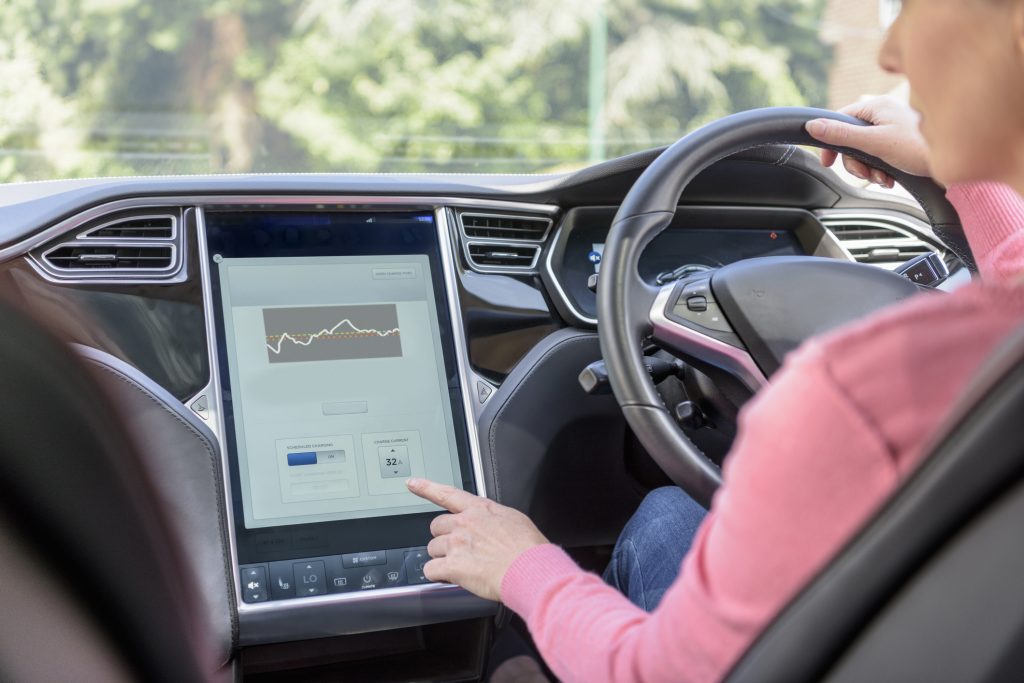
BMW illustrates how connectivity is becoming an operating platform. Verizon and KDDI now provide 5G Standalone and LTE telematics connectivity for newly manufactured BMW Group vehicles in the US, including BMW and MINI. KDDI’s Global Communications Platform gives BMW control over connectivity while using local network infrastructure.
The opportunity spans remote diagnostics, software updates, and evolving passenger experiences. BMW’s recent opt-in Spider-Man animation for suitably equipped vehicles received mixed reactions but showed how manufacturers can refresh the cockpit after purchase. Our reading is that connected services increasingly shape both operational performance and the customer relationship.
How do emergency connectivity requirements affect eSIM selection?
In short, safety raises the stakes for vehicle fleet owners to adopt eSIMs. India’s AIS-140 framework addresses vehicle tracking and emergency buttons in applicable public service vehicles.
In Europe, new M1 and N1 vehicle types must support packet-switched NG eCall from 2026. ABI Research highlights growing convergence between emergency communications, sensing, and vehicle intelligence
These developments make recovery behavior a design priority. Emergency profile handling in SGP.32 v1.3 is relevant to that architecture, but eSIM support alone does not establish regulatory compliance. Manufacturers must validate the complete emergency service, including the telematics control unit, network, and response infrastructure.
How are eSIMs fit in for passenger vehicle fleets and rail or rolling stock transport?
Network Rail offers an operational example. Motion Applied, formerly McLaren Applied, equips 14 infrastructure monitoring trains with multi-network 5G connectivity across a railway spanning more than 20,000 miles of track. Faster transmission of monitoring data helps engineers identify problems and prioritize maintenance.

The main takeaway for rolling stock manufacturers and fleet operators is to specify connectivity around the operational outcome: usable data arriving when maintenance decisions depend on it. TLDR version: Evaluate coverage, recovery, and remote management together.
There is another consideration that those managing fleets for public transport, autonomous fleets, robotaxis, and more should account for: Do you build or buy the capability for managing and keeping systems such as your eSIMs and remote management via eIM interoperable and maximize their potential for integration? Building these from scratch can stack up significant engineering effort that may be better invested in other propositional enhancements.
Transforma insights’ Jim Morrish shares what it takes to choose between the build or buy options for remote eSIM management such that later on you can avail the benefits of integrations for orchestration, AI and compliance with ease.
See the Transforma Insight “Managing eSIM connectivity at scale for business edge: A build vs buy guide for executives” white paper ahead of your next product review meeting.
Click here to open your copy
How should manufacturers evaluate SGP.32 automotive eSIMs?
Ask suppliers: “Can we activate, change, and recover operator profiles remotely across our target markets, without redesigning the vehicle?”
Require evidence of interoperability between the eSIM, device-side agent with modules- IPAe or IPAd, eSIM management eSIM IoT Remote Manager (eIM), and operator provisioning systems. Test interrupted downloads, loss of connectivity, and recovery before fleet deployment. Establish who controls subscriptions, management access, and supplier migration, alongside local connectivity and roaming requirements.
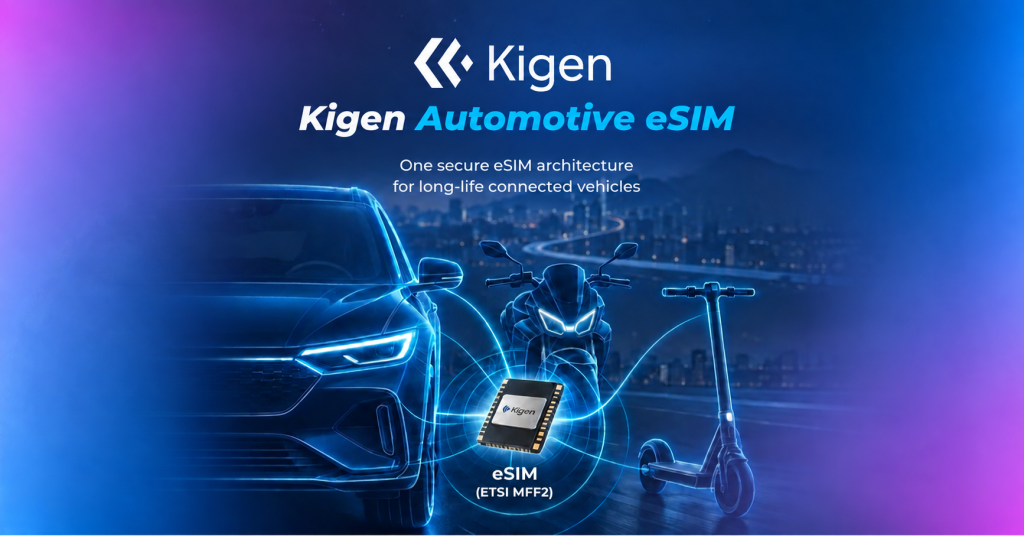
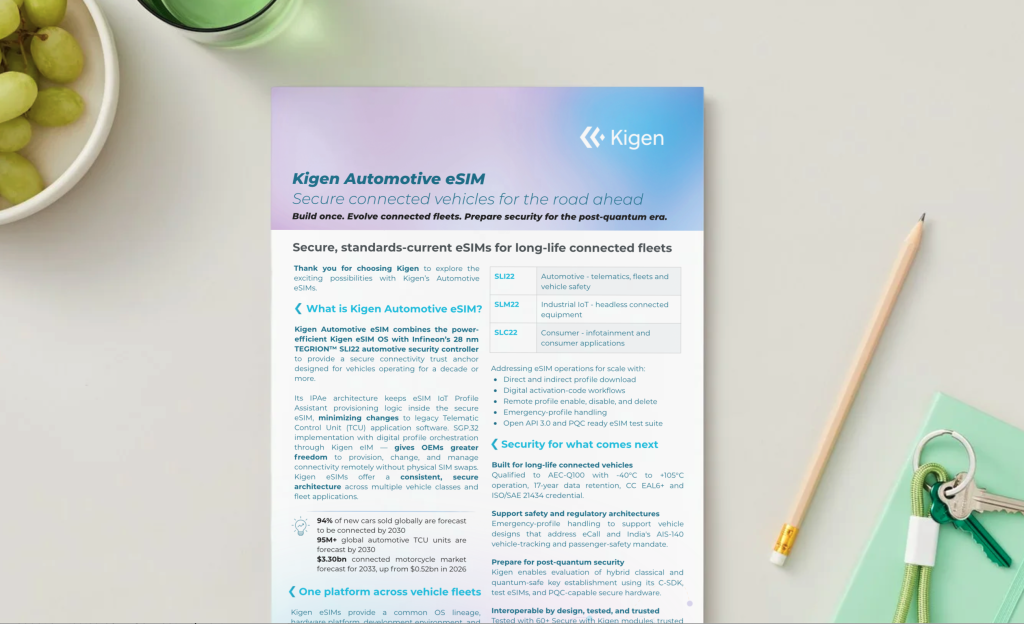
Kigen’s new Automotive eSIM combines its eSIM OS with Infineon’s TEGRION SLI22 automotive security controller. It is the industry’s first eSA-certified eSIM supporting SGP.32 v1.3, including emergency profile handling. Shared tools and management architecture across Kigen’s automotive, consumer, and industrial portfolio help reduce development fragmentation.
Further, fleets today are, as we have discussed earlier, expected to last past 2035 or 2040. These demand automotive-environment certifications and assurances, as well as future-proof cybersecurity considerations, in which management of connectivity takes you from factory-fitting directly to digital activations beyond the first purchase cycle.
Jump back to full specs to see what to look for.
Which security and hardware qualifications matter for vehicle eSIMs?
Ask: “What evidence supports this eSIM’s security and reliability throughout our intended service life?”
Review GSMA eSA certification, applicable automotive qualification, temperature limits, data retention, and patch support against the actual installation environment. A soldered package removes removable-SIM contact and access points; the complete system still needs protection against physical and software attacks. Define update responsibilities and support commitments before procurement.
Post-quantum cryptography (PQC) in the automotive and connected-vehicle industry is a strategy to protect modern fleets from “Harvest Now, Decrypt Later” (HNDL) risks and potential attacks, in which long service lives make hardware replacement impractical.
How can fleet developers prepare for post-quantum cybersecurity?
Ask: “Can our TCU and eSIM architecture test hybrid cryptography now and evolve as standards mature?”
Vehicles entering development today may remain operational beyond 2040. Sometimes, HNDL are also referred to as Store-now-decrypt-later (SNDL) risks, therefore, deserve attention during design. While current quantum computers cannot break standard public-key encryption (like RSA or ECC), the idea is that future quantum computers may easily crack them using computationally more advanced algorithms. Typically, the hardware security investment for these are only economical for top tier, but increasingly efforts are underway to make new more suitable options for the wider automotive market, such as prior generation eSIM effort by Crypto Quantique.
Kigen provides a full implementation with an eSIM development suite, including a C-SDK, simulated environment, and eSIMs for evaluating communications using hybrid classical and quantum-safe algorithms on the same platform for OEMs who need this capability for scale and futureproofing.
It is worth noting that PQC is under consideration but not yet part of the published GSMA eSIM specifications.
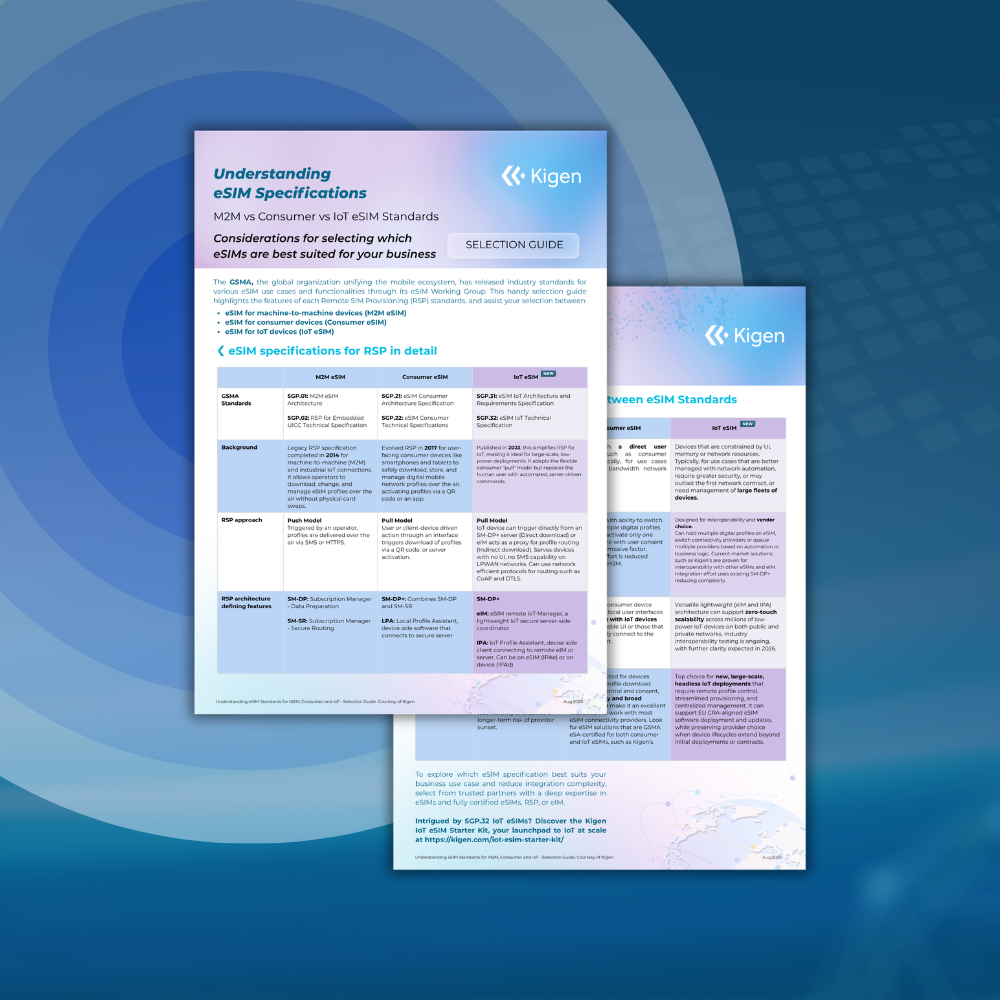
See how to select which GSMA eSIM standards are suited for your applications. See Kigen’s selection guide.
The procurement decision reaches beyond today’s connectivity price. Manufacturers are choosing how securely, independently, and effectively their fleets can evolve for the people who will travel in them tomorrow.
How can secure eSIM connectivity support fleet transactions and fraud detection?
Ask: “Can our connectivity architecture securely connect vehicle data with transaction controls to help detect unauthorized spending?”
Motive’s research found that industry leaders estimated 19% of fleet spending was lost to fraud or theft, rising to 22% in construction. This makes connectivity a financial control consideration.
Secure eSIMs authenticate cellular subscriptions and protect network credentials, while remotely managed connectivity helps keep vehicle data available for fraud detection. Combined with authenticated applications and payment controls, telematics can flag discrepancies between a vehicle’s location and a fuel purchase, charging session, or other transaction.
OEMs should evaluate this complete chain of trust: the eSIM secures network access, while application security, transaction authorization, and analytics provide the additional controls needed to address fraud.
For most of us, 2040 suggests the vehicle fleets that future generations will travel in. Shaping them well starts with the decisions manufacturers make today: how connectivity remains available, how trust is updated, and how fleets retain the freedom to evolve.
Talk with Kigen about your vehicle architecture, deployment markets, and service-life requirements—and how secure eSIMs, interoperable remote management, and development tools can support your next fleet program.