- Resources
- Blog
eSIM Topics Shaping the Industry of IoT and All Things Connected
 Loic Bonvarlet
 Two concurrent shows anchored the week: The Things Conference and IoT Tech Expo. I came not merely to attend but to sense the pulse and map how eSIM, cellular, and IoT architectures are shifting under us, and to share what I believe must now sit squarely on your radar if you lead product, innovation, operations, or manufacturing.
Arriving in Amsterdam: two shows, one shifting tectonic plate
The Things Conference has long been a stronghold of the LoRaWAN / LPWAN community — a place of deep domain exchange, “how do we scale?” debates, and an increasingly eclectic audience. This year, however, its agenda explicitly expanded to include Cellular IoT, hybrid connectivity, and cross-radio architectures. Meanwhile, IoT Tech Expo (running in parallel) offered the cellular and systems world a platform to showcase scale, deployment stories, SIM/eSIM innovations, and the business models behind them.
Walking between stands, I heard a recurring theme voiced with clarity: “As we scale, we need to look for Cellular to ease scaling, especially for newcomers. It’s a case of being able to build to that scale without the infrastructure heavy lifting.” That simple framing captures the shift: confidence in eSIM and IoT cellular is no longer questioned — it is now about how to integrate it effectively to reach scale faster and with less friction.
In threaded sessions, partner meetings, evening dinners, and hallway passings, a few themes came into sharp relief. Here’s what I took away and what I urge you to act upon.
1. Cellular demand is no longer fringe, it’s now core to scale
In past editions, cellular often felt like the newcomer (“that other radio”) at The Things Conference. This time, it was seated at the table. LPWAN and unlicensed technologies remain foundational for ultra-low power and cost sensitivity, but when you begin to design for global scale, ubiquitous reach, resilience, and future proofing, cellular must be in the mix.
The shift is primarily powered by the new GSMA SGP.32 IoT eSIM specification, which brings architecture simplification, leaner agent models, and better support for constrained devices than legacy eSIM standards.
There was a clear complementarity between Cellular and LoRa in gateway deployments, with gateway manufacturers showing strong appetite to add flexibility in how connectivity is enabled particularly in adapting or switching the cellular backhaul.
2. eSIM is riding consumer momentum into industrial IoT
It’s no surprise that the broader awareness of eSIM came from consumer devices including Apple going eSIM-only, Google pushing SIM slot + eSIM models, device makers embedding eSIM by default. That trickle into awareness is now cascading into IoT adopters. In recent weeks, we have Garmin’s Fenix 8 Pro (cellular + satellite), new connected wearables, asset trackers, and even kids’ watches — all ushering an era of eSIM-only and eSIM-first products. This consumer pressure accelerates industrial credibility.
But the real opportunity for the OEM lies in two-fold control:
- Ownership of control
As device maker, you should be able to embed, switch, recover, or re-provision connectivity without depending wholly on a connectivity provider’s constraints.
- Intelligent choice in connectivity
It’s not binary operator switching; it’s layered resilience. Outages, roaming issues, degradation, eSIM allows you to architect fallback, business rules, rescue logic.
In your next design review, don’t ask “Should we add eSIM?” — ask “How do we architect intelligent eSIM layering into our connectivity stack?”
3. The eSIM form factor unlocks new design possibilities
One of my more enjoyable moments was walking prospects through the demo of Kigen’s MFF4 eSIM chipsets , ultra-compact, industrial-grade, and very real. Seeing engineers physically hold them and map them to small form devices (smartwatch, meter, helmet, beacon) is striking. Yes, we moved the “is it possible?” question into “how do we get embedding it into our product?”
You should check our full product update on it in our previous blog (oh, and it’s publicly available). The point is: eSIM is no longer a bulky add-on; it can go anywhere.
4. Faster paths to deployment through eSIM and module ecosystems
4. Faster paths to deployment through eSIM and module ecosystems
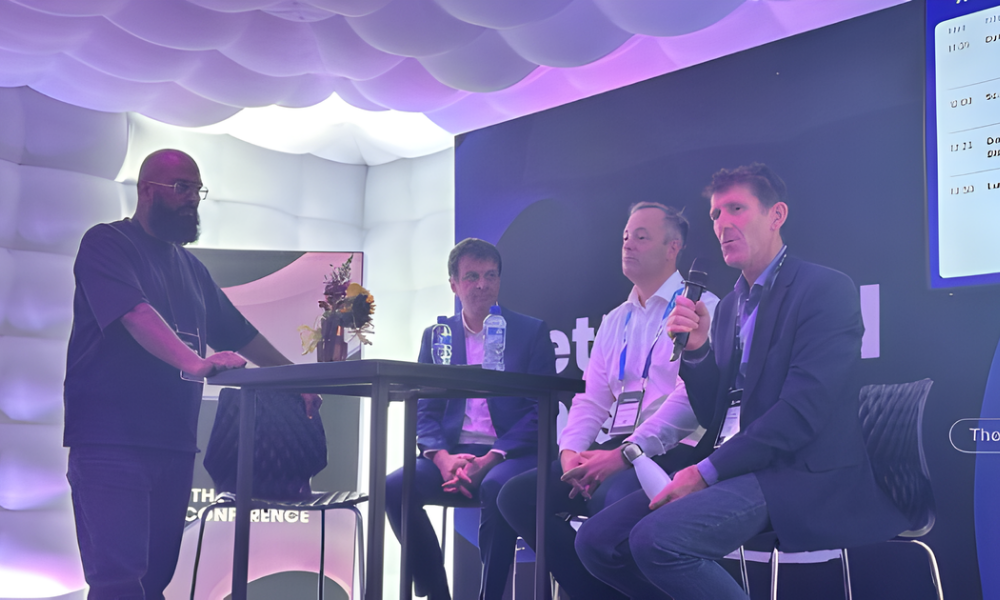
On the panel with Sequans and Nordic, we highlighted the industry’s move from removable SIMs to the IoT-centric SGP.32 eSIM standard. The SIM’s 30-year legacy of hardware-backed security remains a foundation, but the focus is now on flexible pathways — embedding connectivity at manufacture, during device assembly, or in the field. With over 50 modules tested, turnkey developer solutions from Nordic Semiconductor, and real deployments like Itron’s collaboration with Kigen and Sequans for In-Factory Profile Provisioning, the message was clear: the ecosystem is ready to simplify IoT deployment and scale with confidence
In partner demos, I watched a Nordic nRF9151 + Thingy:91X board negotiate with Monogoto and be eSIM profile downloadable in under a minute live in the booth. See it below:
It was great to see it deliver a true step by step developer experience which stands true in action. The interoperability granted by SGP.32, when paired with robustly tested Secure with Kigen modules and dev kits, gives you a fast lane to proof-of-concept deployments.
It’s no longer mandatory to reinvent the wheel in provisioning stacks. Use validated hardware + toolchain, plug in your preferred connectivity provider, and get to field trials quickly.
5. Rethink your RSP / provisioning model: pre-load, in-factory, remote
One of the hall conversations bubbled into a pattern: many product teams still assume eSIM provisioning must mimic legacy SM-DP+ mid-field models. That’s no longer optimal, particularly in IoT. With SGP.32, you can mix approaches:
- Pre-loading (in standalone eSIM or in cellular module)
- In Factory Profile Provisioning (IFPP) during final assembly at the ODM or OEM site
- Remote provisioning / updates via eIM (eSIM IoT remote Manager)
This flexibility enables strategic benefits for example, shipping a single SKU and only enabling connectivity later, or delaying region-specific profile binding until after QA or distribution. Several major players (e.g. NuvoLinQ) are adopting Kigen’s eSIMs with this flexibility built in, hedging against connectivity disruptions or region reconfiguration.
6. Orchestration, profiles and eIM choice matter (not just eSIM)
The last, and perhaps the deepest, lesson: the real differentiation and risk lie not just in embedding eSIM, but in how you orchestrate the connectivity profile operations. In practical terms, your eIM must support multiple profiles, business-rule logic, rescue fallback, autonomous steering not just a one-time switchover.
Here Kigen’s eIM is a key enabler: a scalable IoT remote manager purpose-built for SGP.32 v1.2, hosted in Kigen’s SAS-accredited data center. For scale, the eIM architecture must manage large fleets, coordinate profile operations, handle secure logic, support indirect downloads, and automate cross-profile deployments.
If you’re choosing your eIM partner, do not settle for vendors just meeting the minimal spec, look for scale, security posture, orchestration features via pre-integrations to CMP such as Simetric and IOTM, private / public network hybrid support, and resilience to internet threats.
If you’d like to deeply explore how to pick the right configuration for eSIM + eIM, I invite you to talk to a Kigen expert, as we are purpose-built for this.
Closing reflections: “niche within a niche” — but momentum is real
At The Things Conference, one perceptive write-up observed that IoT is still “a niche within a niche within a niche” — yet hinted that the mood has subtly shifted: confidence is growing. (James Blackman, RCR Wireless News) Indeed, I felt that too. In every meeting, the tone was less speculative and more operational: “How do we do this?” not “Does it make sense?”
As I boarded my return flight, I felt invigorated by the clarity emerging across those four days. The industry is quietly pivoting from open questions to differentiating execution. The topics I describe above aren’t theoretical — they are already shaping next-gen deployments.
To senior leaders reading this: carry these learnings into your R&D planning, your architecture reviews, your supply chain decisions. Revisit your roadmap and ask: do we have a credible path to eSIM / cellular scale? Are we locked into legacy provisioning assumptions? Is our orchestration layer strong enough?
I look forward to running into you — in booth halls, at future events, or over a call. We’ll be publishing our event wrap list soon — check Kigen’s announcements. And if you see another eSIM development I’ve missed, drop us a line, or add to our #FutureofSIM dialogue.
Here’s to building connected futures together.