- Resources
- Blog
- Case Study
- News
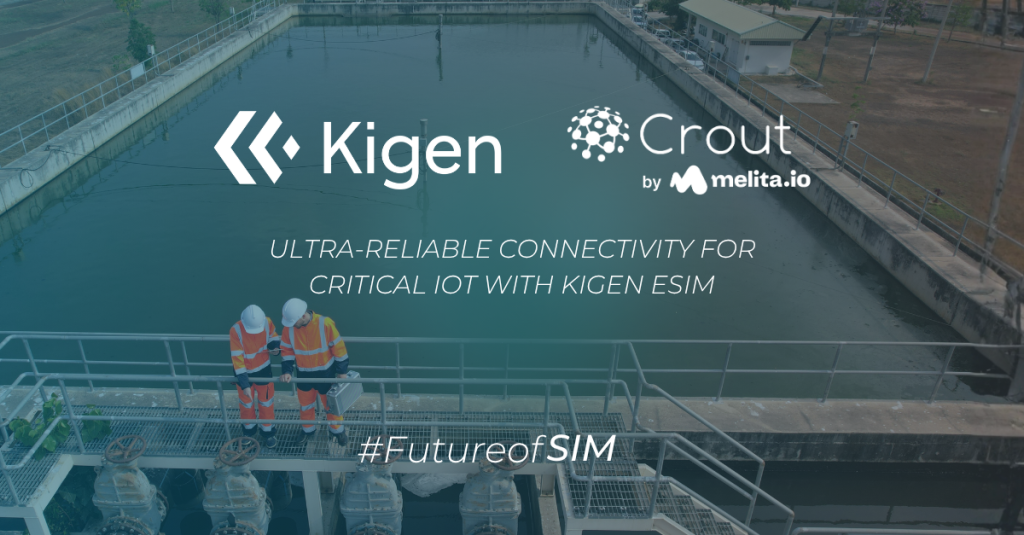
Ultra-reliable connectivity for Critical IoT: Crout and Melita’s journey with Kigen eSIMs

Utra-reliable connectivity for Critical IoT: Crout and Melita’s journey with Kigen eSIMs
When cold chains are monitored, cash transactions are secured, vital data is transmitted, alarm systems are controlled, and connectivity must remain reliable. Enterprises across Europe now use Crout and Telefónica Deutschland’s joint solution 2CoreSIM, an integrated IoT connectivity solution designed for critical industry processes and applications. Engineered for Critical IoT, where resilience, predictability, lifecycle stability, and operational continuity are paramount, the solution’s technical core lies in the SIM itself. 2CoreSIM is implemented with the latest Kigen IoT eSIMs, certified to the GSMA eSA Scheme for SGP.32 IoT eSIMs, and managed via Kigen’s GSMA SAS-certified hosted eIM solution.
“Critical IoT will only scale when connected operations can reliably deliver business outcomes through greater autonomy, including secure provisioning of connectivity regardless of the underlying transport protocol,” said Vincent Korstanje, CEO of Kigen. “We are proud that Crout and Melita have entrusted Kigen’s eSIM and eIM solutions to support this shared vision. It is an important step towards securing the industrial edge and enabling the next generation of process innovation.”
Crout and Melita started with the Kigen eIM solution when it launched as a world-first and achieved GSMA SAS certification in 2025. Their shared vision was to offer reliable connectivity for businesses that view it not as an add-on, but as part of their core operations.
This journey allowed them to recognize the vital role and value remote RSP component eIM brings. The eIM enables better connectivity control, allowing both partners to combine stronger control and high-availability networks with strong IoT expertise for their customers.
“Crout develops IoT solutions for companies that view connectivity not as an add-on, but as part of their core business. If temperature data doesn’t arrive, a logistics problem becomes a quality risk, or if video surveillance and alarm systems fail, this can lead to immediate security risks and financial consequences. Even wildfire and flood early-warning systems only work if alerts are received in a timely manner. Together with Telefónica Deutschland, we are therefore bringing resilient connectivity to places where outages are particularly costly, risky, or business-critical. The solution reduces complexity and embeds reliability directly into the SIM card.” Frank Kiesewetter CEO, Crout.
“Digital processes are becoming increasingly business-critical for companies. Anyone who monitors the flow of goods, transmits medical data, controls security systems, or operates backup systems needs connectivity that works even in the event of a disruption. The partnership with Crout demonstrates how strong networks, IoT expertise, and intelligent SIM technology come together to create a solution that gives companies greater reliability and operational control.” Jörg Kablitz Chief Partner & Wholesale Officer, Telefónica Deutschland.
How 2CoreSIM uses SGP.32 with Kigen IoT eSIMs
Leveraging Kigen’s full eSIM and eIM solution, 2CoreSIM eUICC hosts two independent operator profiles. One uses Telefónica Deutschland, while the other provides access through Melita. If the primary connection is unavailable or no longer meets the required quality, the eSIM can autonomously activate the alternative profile and rebuild the data connection over the second infrastructure.
This switching logic operates locally on the device with the IoT Profile Assistant (IPAe) embedded in the eSIM. This removes the need for additional applications or manual profile reconfiguration, embedding ultra-reliability directly into the connectivity layer.
The solution goes beyond traditional roaming, reducing complexity. Demanding industrial requirements cannot be met solely by having access to multiple radio networks, but rather by combining separate network profiles and core infrastructure on a single SIM, with local decision logic and defined fallback behavior for critical use cases.
eSIMs built for high availability industrial networks
Critical IoT industries must operate uninterrupted and often require profile switching within ultra-short operational windows. Additionally, they may require the ability to securely deliver profiles to remote endpoints that are not directly connected to the internet, and similarly, secure delivery via bearers beyond HTTPS and SMS. If the endpoint data fails to arrive, the consequences can include operational disruption, compromised quality or security, and significant financial loss.
Kigen eSIMs are designed and certified for these industrial requirements. Alongside GSMA eSA-certified security, they support demanding environments over long deployment lifecycles of 10-20 years, including temperatures from -40°C to +105°C. Kigen also extends standardized eSIM capabilities with features such as indirect profile download, IPAe-based integration, and secure profile transport over protocols commonly used by constrained and industrial IoT devices.
Kigen provides the only eSIM solution that combines features within SGP.32 IoT eSIM specifications that directly address the needs of critical IoT, such as indirect profile download, IPAe and IPAd tools for client-side integration, and secure profile transport over protocols commonly used by constrained and industrial IoT devices.
Addressing growth in critical IoT
These capabilities apply across seamless monitoring of assets in logistics, high-value goods, containers, or cash-in-transit vehicles. In food retail and pharmaceutical logistics, temperature data from cold chains can be transmitted more reliably. In healthcare, resilient connectivity supports the transmission of vital signs and device data. In industrial and security settings, sensors, machines, alarm systems, video surveillance, and backup solutions can remain operational even when the primary connection fails.
The same applies to critical infrastructure and early-warning systems. Pumping stations, water treatment plants, energy sites, and remote technical installations depend on reliable data transmission. Flood monitoring, wildfire detection, and environmental warning systems only create value if alerts arrive in time.
Across Europe, critical infrastructure is becoming connected infrastructure. Recent EU and EIB investment is accelerating remote monitoring and automation across transport, electricity, water, and emergency-warning systems, with new EU transport infrastructure funding of EUR 1.1 billion explicitly calling for digital road infrastructure, ports, freight-related networks and resilient transport infrastructure.
Newsletter Sign-up// – Light Gray Inline
Sign-up for our newsletter to receive the latest from Kigen.
A partnership of strengths
Telefónica Deutschland provides a modern, highly developed mobile network, with a core and antenna footprint of more than 29,000 sites. That network powers the one profile. Crout contributes IoT expertise, Kigen’s eSIM technology, and day-to-day customer relationships. Together with Melita, which supplies the second network on a separate infrastructure from the first, Crout integrates this into a single solution for highly available IoT connections.
About Crout
Crout is a strategic division of melita.io, combining the stability and resources of a European mobile network operator with the agility and expertise of an IoT specialist. Established in Stuttgart in 2012 as ASPIDER M2M GmbH, Crout has been delivering secure and scalable IoT connectivity solutions for businesses worldwide.
With deep expertise in IoT connectivity, Crout enables organizations to connect, manage and scale their IoT deployments across industries. Its connectivity portfolio supports 2G, 3G, 4G, 5G, NB-IoT, LTE-M, satellite 5G NTN, LoRaWAN, mioty and Mesh technologies.
Crout provides an integrated IoT connectivity ecosystem, including an in-house Remote SIM Provisioning platform for centralized connectivity management, supported by dedicated operational expertise and a Network Operations Centre.
The company serves a wide range of sectors including logistics, smart cities, healthcare, industrial automation, security and critical infrastructure, helping organizations deploy reliable IoT solutions across markets.
The latest addition to the portfolio is 2CoreSIM connectivity solution combining two independent network profiles on a single physical SIM card or eSIM. Developed with Telefónica Deutschland, with Kigen providing eSIM secure technology expertise, it enables automatic switching between networks to support applications where connectivity continuity is essential.
One for IoT — one trusted partner for a connected future.
About melita.io
melita.io is the dedicated IoT brand of Melita Limited, backed by Goldman Sachs Alternatives Infrastructure. With over 30 years of telecommunications experience, Melita is a European mobile network operator with direct ownership and control of critical connectivity infrastructure, including its mobile network, core network, fixed infrastructure, data centers, and international connectivity.
Through more than 300 roaming agreements, melita.io delivers secure, reliable and resilient IoT connectivity across more than 185 countries. Its intelligent IoT SIM solutions provide multi-network access, automatic network selection and failover capabilities, helping devices remain connected across borders and in demanding operational environments.
Built on a technology-agnostic approach, melita.io enables organizations to design and deploy IoT solutions across multiple industries by combining mobile connectivity, eSIM capabilities, IoT platforms and partner technologies to address diverse business requirements. In addition to cellular connectivity, melita.io also provides LoRaWAN® connectivity, operating dedicated networks in Malta and Germany to support smart city and industrial IoT deployments.
Headquartered in Malta, with international operations and offices in Germany and Sweden, and local presence in the UK, the Netherlands, France, Spain and Israel, melita.io works with customers and partners globally to deliver scalable, secure and resilient IoT solutions.
As members of the GSMA and the LoRa Alliance®, melita.io continues to drive IoT innovation by combining secure connectivity, operational expertise and trusted partnerships to help organizations build reliable and scalable connected solutions.