- Resources
- Blog
How IFPP Solves Connected Product Handover Challenges
 Jean-Louis Carrara
 Author

Jean-Louis Carrara
SVP Sales and Business Development, Kigen
In our last blog, we explored why smart connectivity belongs early in IoT product design. For those still assessing the impact: it’s worth consulting — because what once seemed like a futuristic ambition is now a practical advantage.
Today, product leaders can build more scalable solutions, make product cycles more agile, and expand device deployments further across the globe — without needing extensive infrastructure changes or deep supply chain complexities.
This shift matters most with the key transitions in product development — from prototype to production, and ultimately to field enablement. It’s at these handovers that cost, time, and risk accumulate. And it’s where a new model of profile provisioning —enabled by Kigen’s In-Factory Profile Provisioning (IFPP) — delivers measurable value.
Product Development Is Moving Faster—But Riskier
Product managers and engineering leaders are under pressure to deliver more innovation, faster. IDC estimates that by 2027, 75% of all devices will be connected by default. At the same time, McKinsey cites that nearly 70% of manufacturers report that product complexity is one of their top challenges.
The implications for IoT product teams are profound. According to a 2024 EY Future of Manufacturing report, engineering cycles are compressing by 25–35% across key verticals like industrial IoT, automotive, and energy. But while design timelines are shrinking, manufacturing infrastructure hasn’t always kept pace.
Connected products are increasingly global, and designing for connectivity across markets, technologies, and use cases requires early, coordinated planning. This is particularly difficult when manufacturing environments remain offline, fragmented, or constrained by long provisioning lead times.
Why Provisioning Decisions Are Product Strategy
Let’s say your team is designing a new generation of smart meters or evolving a logistics tracker into a globally connected commercial device. At this point, you’re considering SIM form factors, firmware updates, and regulatory compliance — but the real constraint is SKU complexity.
Our lead customers — ranging from top-tier wearable OEMs to leading smart metering manufacturers — shared a common reality:
- A soldered eSIM component means a new SKU.
- A different SIM profile in a soldered eSIM means a new SKU.
- A hardware configuration tweak? Again, a new SKU.
- A mobile operator’s SIM profile, sourced through each different end company, means a new SKU (as those connectivity profiles are allocated to the utility customers’ Connectivity Management Platform or CMP account). Even if it is the same operator’s profile. You guessed it – a new SKU.
Now, add to that the desire for failover networks, satellite resilience, or MVNO partnerships — each potentially requiring a different provisioning configuration. Suddenly, your “connected product” requires 10+ hardware variants, each with its own MOQ, lead time, and logistics burden.
With Kigen’s IFPP trial, teams can shift from fixed SKUs to configuration-on-demand. Software-defined provisioning allows a single stock-keeping unit to be reused and adapted, meaning engineers define the provisioning logic once and adapt it to use cases later.
In trials, a top 5 smart meter manufacturer saw timelines for obtaining secure profile delivery in their factory fall from 6–8 weeks to less than 24 hours. Critically, no minimum order quantities were required. It’s a supply chain game-changer.
Three Critical Moments IFPP Simplifies
1. High-Speed Manufacturing – Without Disruption
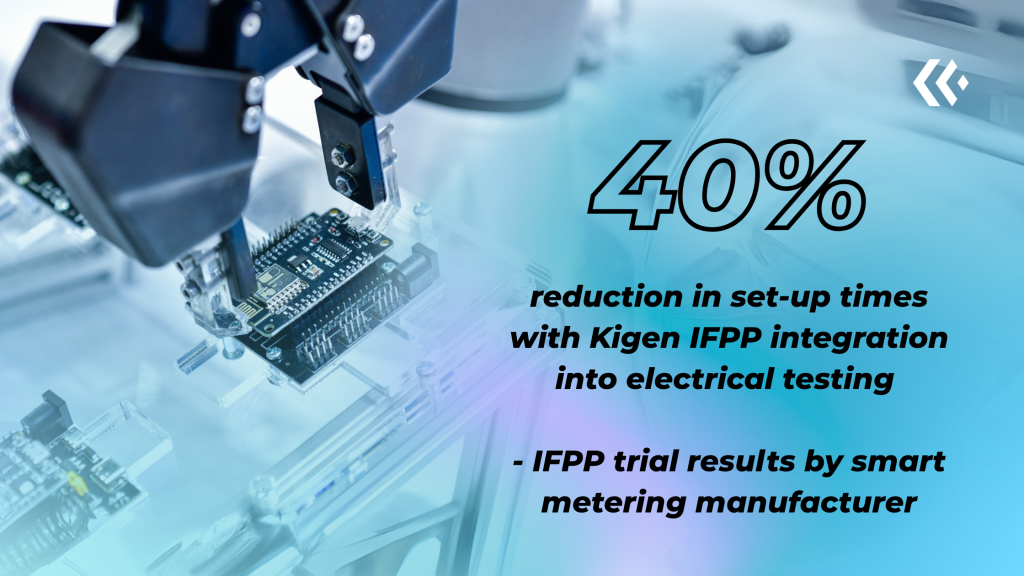
In high-throughput environments, line stoppages are expensive. One leading logistics device maker used IFPP for batch provisioning on a panel or array of PCBs. ABI Research’s white paper, titled “From Standards To Scale: An OEM’s Guide To IoT eSIM Success”, bridges the capabilities brought to bear by the GSMA SGP.32 standard and the emerging SGP.42 standard, covering this as a stepping stone for futureproofing. The device maker’s experience in the trial demonstrated use of IFPP for integrating profile loading into electrical test points, avoiding downstream configuration and reducing setup time by 40%.
2. Prototype-to-Production – Cutting Handover Gaps
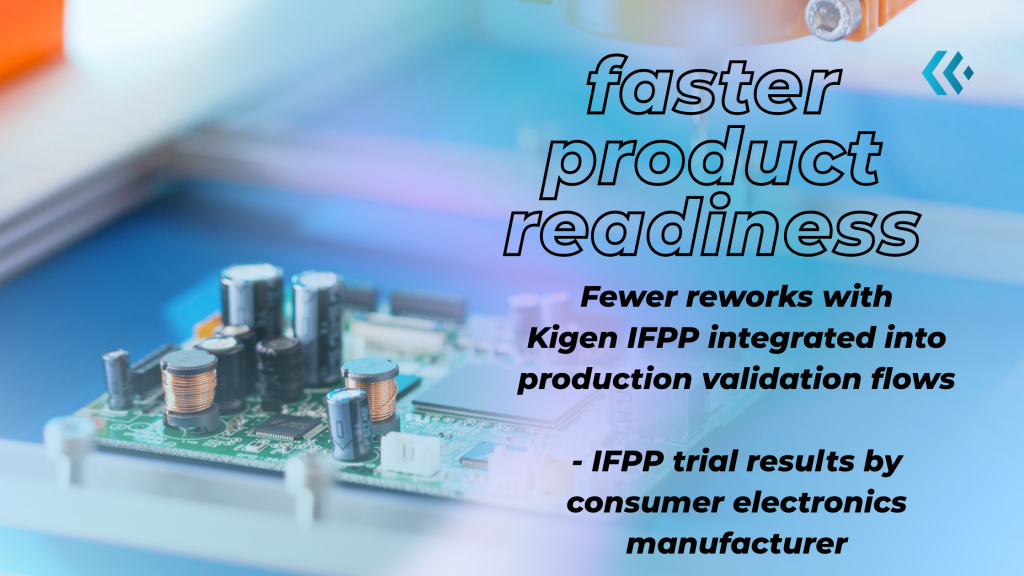
A top-tier consumer electronics brand used Kigen Pulse with its factory toolchain to simulate production behavior over its native test infrastructure, using established interfaces without modifying existing tooling. This enabled real-life testing of network behavior—even with air-gapped setups—and validated provisioning workflows before tooling lines were finalized. The result? Fewer reworks and faster product readiness.
3. Field Enablement – Personalized, Resilient Connectivity
Network conditions can vary dramatically in large-scale outdoor deployments, such as utilities or infrastructure. One manufacturer’s firmware now leverages IFPP’s OTA-friendly file transfer utility to receive pre-bound profiles wirelessly—even over sub-GHz channels like 900MHz or via NFC. These profiles support fallback and rescue logic for field reliability, which is vital for constrained, headless devices.
Redefining the Factory Boundary
Traditionally, provisioning that originated from the core connectivity provider network relied on SM-DP+ infrastructure for secure profile delivery. This has proved to be a process that is complex, cost-intensive, and reliant on stable public internet. For many manufacturers, this was a non-starter. Kigen’s IFPP changes that.
With our trial kit, customers have shown how provisioning can happen:
- In distributed factory networks across the U.S. and EMEA
- Via private handheld tools during field installation
- In air-gapped environments without changing production infrastructure
This is a redefinition of the factory boundary—not just technically, but commercially.
And with new eSIM standards like SGP.32 (and the emerging framework with SGP.42) making modular provisioning more viable, the timing has never been better.
Why Leaders Are Betting on IFPP
A recent Transforma Insights study highlighted that over 85% of connected device manufacturers expect to move toward programmable connectivity models by 2027. Our customers are already there.
They’re not waiting for regulatory mandates or market fragmentation to push them—they’re using IFPP to steer their product strategy more agilely. Whether it’s reducing operational costs, improving field support, or streamlining certification paths, IFPP is the connective tissue enabling confident global scale.
Kigen IFPP also integrates seamlessly with Kigen’s eIM (eSIM remote IoT Manager) solution, compliant to GSMA SGP.32 eSIM specification
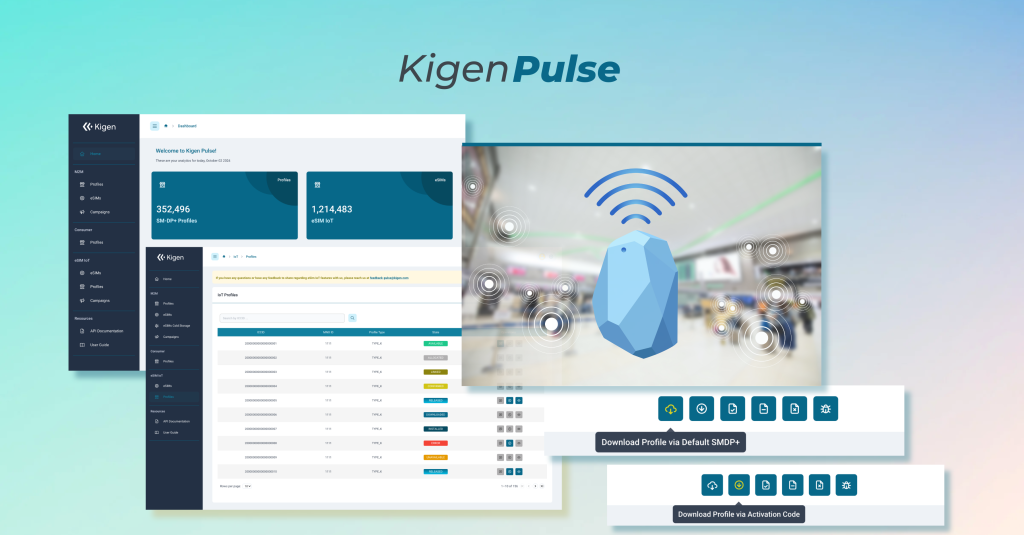
- Kigen Pulse for fleet-wide observability of profile state operations and Open APIs 3.0 endpoints for integration with CMPs, billing systems, and platforms bringing single pane of glass visibility
- C-SDK that brings middleware tools and reference source code for device portability, integrated into Kigen Pulse
Final Thought: Build for Scale, Not Just Pilots
In connected product innovation, early decisions ripple across the entire lifecycle. IFPP is designed for those high-stakes transitions — prototype to product, factory to field.
It’s why the world’s most trusted device makers are trialing our IFPP solutions and preparing their devices, their operations, and their manufacturing for the future.
They see what’s coming — and they’re not waiting to be reactive. They’re redesigning what’s possible, from the first solder to the final update.
Learn how Kigen’s IFPP Trial Kit can help scale faster, smarter, and with fewer compromises.
Start your trial today