- Resources
- Blog
The Future of eSIM Hardware
 Loic Bonvarlet
 A Comprehensive Guide to Form Factors and the Kigen MFF4
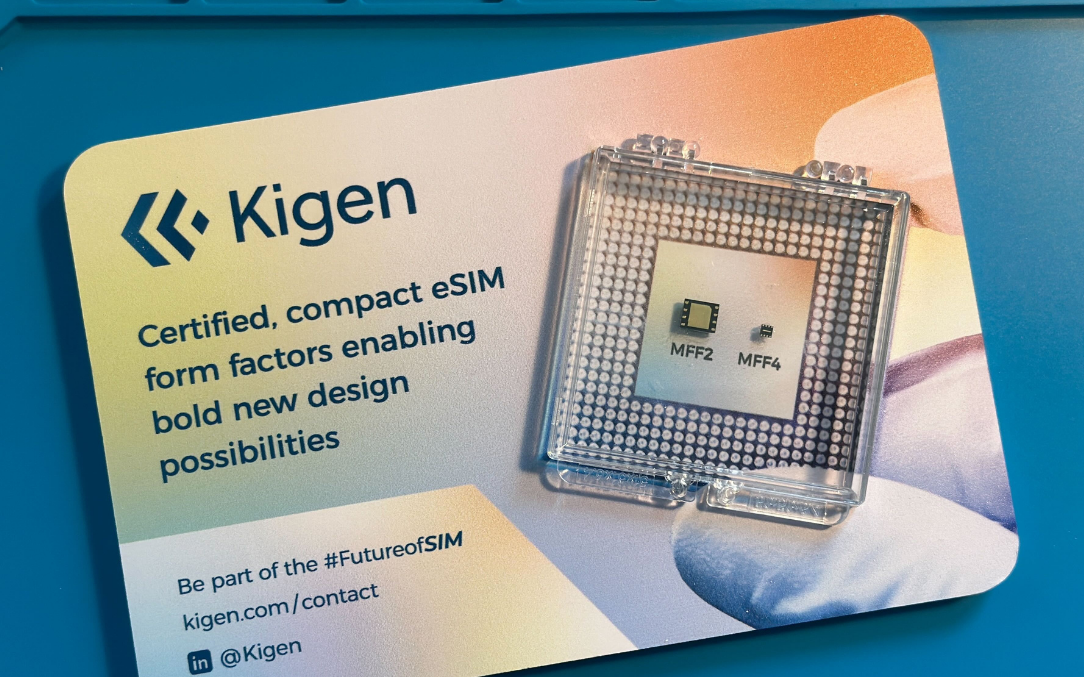
Several hardware considerations are involved when defining cellular connectivity for your product, including selecting the appropriate form factor. In this article, we’ll explain how eSIM works at the hardware level, why form factors matter, and why Kigen is the only supplier today offering a production-grade MFF4 eSIM — measuring only 2 mm x 2 mm: tiny, with outsized impact!
Unlike iSIM, which integrates directly into a system-on-chip, MFF4 remains a discrete hardware component. But it is far smaller than earlier soldered standards such as MFF2 (5mmx6mm), delivering space savings without sacrificing reliability or security. And product managers, embedded developers and product leaders all take note: Kigen is the first vendor offering the compact MFF4 eUICCs today.
Available from Kigen for the past year, MFF4 has already been designed into commercial products across industrial and consumer markets — from smart metering fleets and connected gateways to wearables, e-bikes, and mobility accessories. With high demand across these sectors, Kigen is now enabling broader release of MFF4 to support the next wave of IoT innovation.
What is eSIM hardware? From eUICC to soldered integration
At its core, the “eSIM” functionality is enabled by a chip known as an eUICC (Embedded Universal Integrated Circuit Card). The eUICC is the secure element within a device that stores operator profiles, executes authentication logic, and enables over-the-air profile updates via Remote SIM Provisioning (RSP).
Traditionally, SIM cards were removable — 1FF down to 4FF formats — where the SIM chip sits inside a plastic card and can be inserted or removed. In contrast, modern eSIM deployments typically involve soldering the eUICC chip directly onto the device’s printed circuit board (PCB). In effect, the SIM becomes internal and inseparable.
Even though many use “eSIM” and “eUICC” interchangeably, the distinction matters: eSIM often refers to the embedded hardware plus software combination, while eUICC is strictly the SIM OS and secure module. That said, eUICC can also be used in removable SIMs (2FF, 3FF, 4FF), not just embedded ones.
By embedding the chip, device makers “own” the eSIM — they aren’t dependent on the end user to insert or remove physical SIMs, and OEMs can deliver devices with connectivity built in from the factory (often called In-Factory Profile Provisioning, or IFPP).
Another advantage: eSIMs (i.e. eUICC chips) can be packaged and supplied on reels instead of bulky SIM trays, simplifying modern high-volume assembly and reducing BOM complexity.
Why does the form factor of the eUICC matter?
You might think, “Isn’t a SIM chip a SIM chip?” In practice, form factor brings important tradeoffs, especially for IoT and constrained devices:
- Space & board real estate: A more compact form factor frees up room for other electronics, sensors, batteries, radios, or simply enables a smaller device.
- Thermal, mechanical, and RF constraints: Fewer, smaller, or differently placed pins can ease routing, reduce interference, or improve reliability.
- Memory & OS footprint pressure: Smaller form factors sometimes come with more stringent constraints on memory, storage or energy. Many SIM OSes are relatively heavy; tuning them to run efficiently on minimal silicon is nontrivial.
- Regulatory, security, and update responsibilities: As regulators (e.g. under the Radio Equipment Directive or via cellular certifications) increasingly require devices to remain updatable, the eSIM must remain trustworthy over full device lifetime. Efficient, compact form factors that don’t compromise on security or performance help OEMs meet these obligations.
Kigen’s engineering has optimized its eSIM OS specifically for memory-constrained and energy-efficient IoT devices — even in MFF4 form — meaning that multiple operator profiles and full RSP capability remain supported.
For device makers, this means more headroom for innovation: you can prioritize sensors, radios, battery, or other design features instead of worrying about SIM overhead.
eUICC and eSIM form factors: a quick guide
Form factors for SIM and eSIM are governed by ETSI standards (notably ETSI TS 102 671), which define physical, electrical, and environmental specifications for various UICC packages.
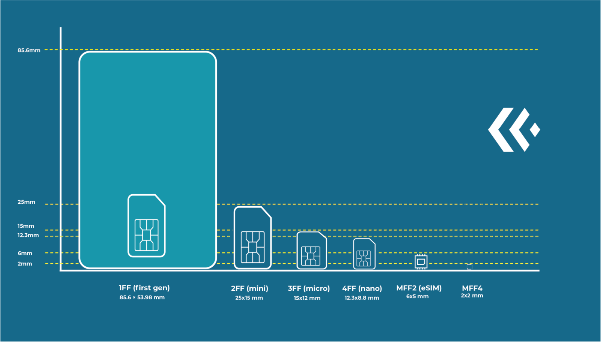
Here’s a simplified hierarchy:
- 1FF (full SIM card)
- 2FF (mini SIM)
- 3FF (micro SIM)
- 4FF (nano SIM)
These are the classical removable SIM card formats used in phones and devices.
- MFF2 — the first common embedded (soldered) SIM form factor.
In IoT, many vendors equate “eSIM” to MFF2. ETSI states MFF2 is 5 × 6 × 0.75 mm with 8 pins, and supports industrial temperature ranges.
- MFF3 – Defined by ETSI with a 10-pin package in accordance with JEDEC MO-229F, with dimensions 3 x 3 x 0.65 mm.
- MFF4 — a new, ultra-compact 8-pin soldered package (JEDEC MO-229F compliance) with a nominal horizontal size of 2.00 ± 0.15 mm (thickness per MO-229F).
The contact pin assignments map UICC signals (VCC, RST, CLK, IO, I3C / SPI lines) in a compact layout.
Not all vendors support every form factor. Many support up to MFF2, but Kigen is currently the only eSIM vendor offering production-grade MFF4 in commercial deployments with RSP.
Other compact formats, such as USON-8, WLCSP are known in niche domains. (They are variants or alternative packaging styles.)
Because eSIM and eUICC are standards-agnostic in principle, you could run the same OS across 2FF, MFF2, MFF4, or even iSIM form factors. But the physical constraints shift. The memory size of the chip will determine how versatile your OS of choice can be in supporting the functions needed to operate the profile state fully.
Industrial-grade and automotive-grade eSIM specifications are defined in ETSI as extended environmental classes (temperature, humidity, corrosion, shock, vibration). For instance, a UICC with TB classification supports –40 °C to +105 °C.
Kigen supports industrial-grade MFF4, providing customers with the flexibility to order devices compliant with stricter classes when required.
Advantages of solderable eSIMs
Switching from removable SIMs to soldered, embedded eSIMs (especially compact ones like MFF4) offers multiple benefits:
Miniaturization and board optimization
By eliminating the SIM tray and socket, you free up valuable PCB area. You also reduce connector transitions, mechanical failures, and risks of contact wear or corrosion.
Stronger security
Because the eSIM is physically embedded, it cannot be easily removed or replaced by an adversary. This hardware-level tamper resistance is stronger than removable SIMs. Additionally, a secure element (SE) layer can host cryptographic operations, protect keys, and enforce robust authentication protocols — thereby preventing unauthorized profile changes or device hacking.
SKU consolidation and supply chain simplicity
Instead of managing multiple regional SIM SKUs, you can ship a single device SKU with an embedded eSIM and load operator profiles later in factory with our In-factory Profile Provisioning or simplify in-field provisioning of the preferred network. This approach, with a generic soldered eSIM device that can be customised at later stages of manufacturing, dramatically simplifies logistics, inventory, and variant management. Kigen has published a whitepaper on how such strategies enable global single-SKU manufacturing via IFPP, showcasing how smart metering and intelligent grid giant, Itron, benefits from these smarter eSIM management strategies.
Longevity & reliability
Without a mechanical socket, you reduce points of failure (e.g. poor contact, dust ingress, mechanical stress). An embedded eSIM is sealed and protected for the product’s lifetime.
Who is currently using MFF4 IoT eSIMs?
Though still early in deployment, MFF4 is gaining adoption in applications where extreme miniaturization is valued:



Secure point-of-sale connectivity
NuvoLinQ’s POS (point-of-sale) devices integrate Kigen’s MFF4 eSIM, supporting dual profiles and low-power consumption to deliver more reliable connectivity. This eSIM solution for ultra-reliable, ultra-secure POS connectivity is designed for payment systems such as card readers and kiosks, ensuring uninterrupted operations with backup connectivity while safeguarding transactions against fraud.
Best eSIM for digital payment IoT secure connectivity for financial POS
Remote SIM Provisioning advantages with MFF4
One of the key advantages of eSIM is Remote SIM Provisioning (RSP). With Kigen MFF4, you retain full RSP capability:
- Profiles can be pre-provisioned in-factory (IFPP) or downloaded later in the field.
- MFF4 is fully compatible with the GSMA certified SGP.32 IoT eSIM standard, enabling multi-profile management and operator switching. Kigen provides Kigen eIM, a remote manager for eSIM lifecycles and a “true source of truth” for profile management.
- You can support multi-operator redundancy (dual or more profiles) to improve reliability and resilience — a feature used in, for example, Kigen eSIM-enabled multi-profile POS systems by NuvoLinQ.
- OTA updates, subscription reconfiguration, and profile state management operations, i.e. which profiles are enabled, disabled, downloaded etc, are all fully supported, even in a compact MFF4.
How to get started with Kigen MFF4 eSIM in your device design
- Contact Kigen
Contact your Kigen account representative to get a demo or to discuss your form factor, temperature class, and application.
- Decide on integration strategy
- If you prefer to embed the eSIM directly on your PCB, Kigen’s MFF4 eSIM hardware (with SIM OS) is available.
- If you want to use a prequalified cellular module compatible with the latest standard SGP.32, Kigen and our partners have extensively tested modules along with the list of modules and evaluation platforms available at Secure with Kigen
- Coordinate early with module/radio and PCB layout teams
Plan pad layout, thermal relief, trace routing, antenna positioning, and supply chain for reel-fed MFF parts.
- Provisioning strategy
Decide whether to use in-factory provisioning or allow for field download of profiles. If using IFPP, integrate Kigen eIM or an equivalent RSP platform.
- Test for environmental, EMC, thermal, and regulatory compliance
Especially in automotive or harsh environments, confirm your class (e.g. –40 to +105 °C) and verify that the embedded eSIM meets reliability expectations.
Looking ahead: iSIM and the next leap
If you’re thinking even further ahead, Kigen helped pioneer iSIM — integrating the eUICC functionality directly inside a system-on-chip (SoC) or modem. With iSIM, there is no discrete eSIM chip — the SIM logic becomes part of the radio SoC itself. Kigen has had commercial iSIM deployments since around 2020, pushing the envelope of integration and miniaturization beyond even MFF4. In that context, MFF4 represents a sweet middle ground — offering extreme compactness while retaining a discrete, secure hardware module as a stepping stone toward full integration.
The evolution of SIM from removable plastic cards to embedded chips (MFF2, MFF4) and ultimately iSIM is reshaping how devices are designed, manufactured, and operated. The hardware form factor of an eUICC is not a mere detail — it affects space, power, security, and design flexibility.
Evaluate Kigen production-grade MFF4 eSIMs for your connected product innovation today. With its optimized SIM OS, support for multiple profiles in memory-constrained environments, and full compliance with GSMA SGP.32 via Kigen eIM, it brings true connectivity flexibility to tomorrow’s smallest devices.
The future of compact, secure, flexible connectivity starts here.